
The names of the rare earth elements may not trip off the tongue of the person on the street but that’s not to say that they haven’t found uses in modern life. Here are five of this first row of the f-block, represented by their applications. Although I’ve plumped for a particular use for aContinue reading “Rare earth applications”
Category Archives: Periodic Blackwork
Twins

Didymium, Di, only existed for 44 years. It was discovered in 1841 by Swedish chemist Carl Mosander, extracted from the ore ceria which was already known to contain cerium and lanthanum. As didymium was very similar to these elements, Mosander named it from the Greek word for twin, and Mendeleev placed it in his originalContinue reading “Twins”
Dark clouds
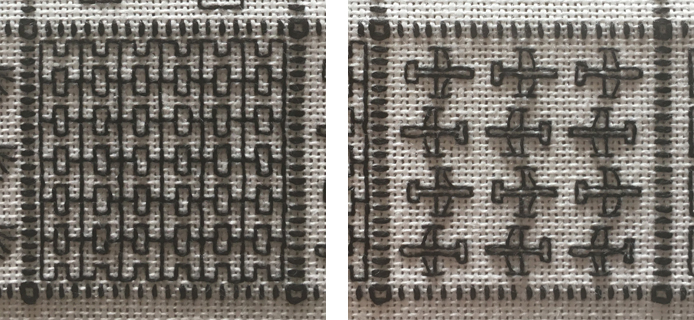
Of all the tales I have read about element discovery, that of einsteinium and fermium truly shocked me. I had assumed that all the man-made elements were the result of planned experiments in the particle accelerators of nuclear science laboratories, but the way in which these two were discovered was both extraordinary and tragic. RatherContinue reading “Dark clouds”
Berkelium, Californium

Today two elements with names derived from places. In fact they are named after the same place. The University of California, Berkeley has been the home of many element discoveries (see Lawrencium and Seaborgium) including berkelium in 1949 and californium in 1950. I have represented berkelium with the most recognisable building at UC Berkeley: theContinue reading “Berkelium, Californium”
Curium

Curium is named for Marie and Pierre Curie, pioneers in the field of radioactivity (a word they coined). When we think of the Curies we tend to think of Nobel Prizes. It is easy to forget the hard grind of the bench chemistry that went into their achievements, and in particular the discovery of theContinue reading “Curium”
Mendelevium – the Periodic Table 152 years on

Despite having made a start on the f-block, I’m still pondering Group 3 and where to place scandium and yttrium. I like the suggestion Kit Chapman made to me, that I somehow represent the dilemma in my table. While I do want to settle on one way or the other for the table as aContinue reading “Mendelevium – the Periodic Table 152 years on”
The Group 3 question

I have almost completed the d-block and it’s come together nicely. The patterns take their inspiration from a wide time-span: from alchemy and classical mythology through to modern technology and applications. Many are pictorial; others are closer to the geometric patterns of traditional blackwork embroidery. As is befitting the transition elements, there are several referencesContinue reading “The Group 3 question”
Technetium

Technetium caused me something of a headache. I struggled to think of a design, and found myself with a gap in the middle of my Periodic Table just as Mendeleev had over 150 years ago. For Mendeleev, the problem was never solved – technetium was not discovered until thirty years after his death – butContinue reading “Technetium”
From Russia…

America was not the only country involved in element discovery in the middle of the 20th Century. Russian scientists too were intent on adding to the Periodic Table and their contribution was initiated by Soviet physicist Georgy Flerov. Like Seaborg in America, Flerov had been involved in developing his country’s first atomic bomb. In fact,Continue reading “From Russia…”
Lawrencium and Seaborgium
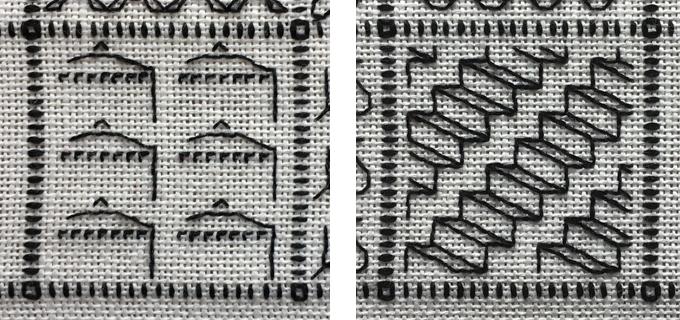
Today two more elements named after scientists – two giants of 20th Century nuclear chemistry, Ernest Lawrence and Glenn Seaborg. The 1939 Nobel Prize in Physics was awarded to Lawrence for his invention of the cyclotron – a device that produces high-energy particles by accelerating them in a spiral path. The energy of these particlesContinue reading “Lawrencium and Seaborgium”
 periodically.blog